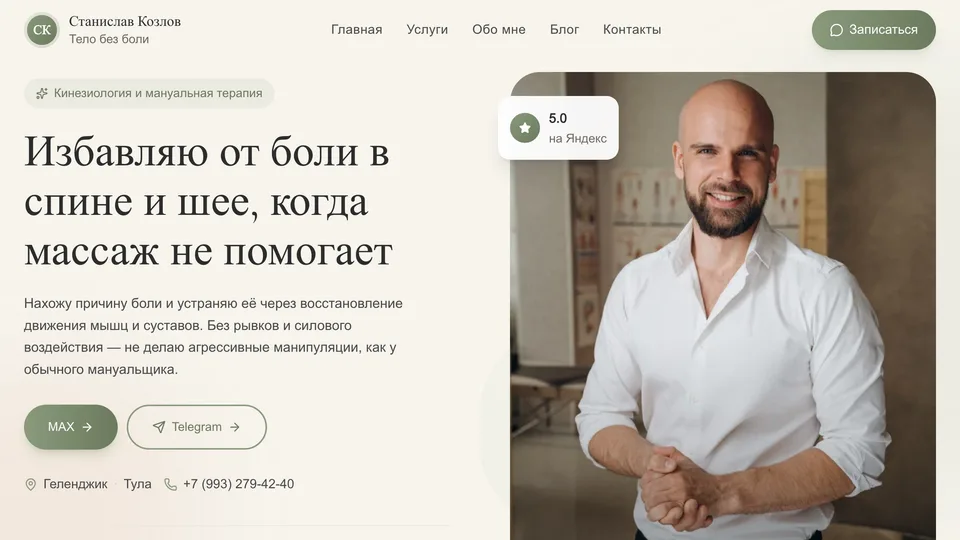
staskoz.com — kinesiologist site with auto-generated blog from Telegram and Lighthouse 90+
A practitioner's site with an auto-updating blog: my brother posts to a Telegram channel, the site updates itself. I imported 100 posts on the initial run.
Why
My brother is a kinesiologist in Gelendzhik, Russia, running the Telegram channel @staskinesio. Each post is a technique photo, an exercise video, or a short case write-up. The goals:
- one entry point: "Google me → book me," without digging through Telegram;
- a blog that updates itself, no editor, no CMS;
- SEO presence on local commercial queries — "osteopath Gelendzhik," "back pain treatment," etc.
How the Telegram-to-blog pipeline works
The main technical bit of this project. I have a Node package, koztv-blog-tools, pulled out of logic I already run on other sites. It:
- connects to Telegram via a Telethon-compatible session;
- pulls messages in batches of 30, stopping at the first one that already exists;
- groups multi-message posts (Telegram splits long text into 2-3 messages — you have to stitch them back);
- deduplicates by
msg_id; - compresses videos with
ffmpegto a reasonable size; - lays everything out as
public/posts/{id}/ru.mdwith media alongside.
On top of that — a GitHub Action that runs daily at 04:00 Moscow (01:00 UTC), invokes the package, commits the delta, and via workflow_run triggers a rebuild and redeploy.

What broke along the way:
- Markdown from bots vs. web client differs. Multi-line bold broke the parser. Fixed with regexes in
koztv-blog-tools. - Slugs were generated from junk in the
Attachments:block. A separatecleanContentstrips attachments before URL generation. - Category assignment uses weighted keyword scoring, not first-match — otherwise "neck warm-up" would land in "Lifestyle" instead of "Exercises."
Performance: from PSI 80 to 90+
The site is static Next.js 16 (output: 'export'). Should be hard to make slow. Mobile PSI with slow-4G emulation and 4× CPU throttling proved otherwise — Lighthouse mobile sat stably at 80-83, with element render delay eating the budget.
What pushed it to 90+:
- Partytown for analytics. GA + Yandex Metrika (~250 KB of JS) moved into a Web Worker via
@qwik.dev/partytown. A thingtag/ym → forwardproxy stays on the main thread, so existingtrackBookAppointmentcalls keep working unchanged. - Inline critical CSS via
beasties(Critters successor). Above-the-fold rules get inlined into a<style>tag; the original stylesheet swaps in async viarel="alternate stylesheet preload" + onload. Cuts 180 ms of render-blocking CSS. font-display: optionalinstead ofswap. PSI reported LCP 5.0 s while local Lighthouse clocked 2.7 s. The gap was a repaint when Nunito arrived over fallback: Next's adjusted-fallback isn't perfect for Cyrillic glyphs, and the second paint triggered LCP. Withoptional, the browser commits to fallback if the woff2 doesn't arrive within ~100 ms. LCP locks to FCP.content-visibility: autoon below-fold sections. The browser skips layout and paint for seven below-fold sections until they scroll into view. CLS stays at 0 thanks tocontain-intrinsic-size.- Pre-compressed assets.
.gzsiblings get generated at build at level 9 (~5% tighter than runtime level 5, and zero CPU per request). Nginx serves them viagzip_static.
Hit a classic regression along the way: after a Server Components refactor, index.html doubled (120 KB → 210 KB). Every <Reveal> wrapper introduced a server→client boundary, and the RSC stream serialized every section as props. Rolled the homepage back to 'use client', and replaced 27 IntersectionObserver instances with one shared RevealActivator mounted in the root layout.
Deploy: 1.1 GB → 100 MB
Every push used to round-trip 1.1 GB through ghcr because 956 MB of Telegram media was baked into the nginx layer. Update one post — a full gigabyte over the wire.
What I did:
Dockerfile:rm -rf out/postsafter build. HTML still references/posts/{id}/..., but the files live on the host now.- A separate rsync job ships
public/posts/to/var/www/staskoz-posts/incrementally (deltas only). - The container mounts that volume read-only.
HEALTHCHECKon the runner image; the deploy step waits forhealthybefore completing.- The Caddyfile is rendered from a template; mv + reload only if the
md5differs.
Result: 100 MB image instead of 1.1 GB, the daily blog cron deploy takes ~1 min instead of 3-4. Hosting is Caddy + nginx-alpine on the same box as my other sites, TLS via Let's Encrypt is auto-provisioned.
SEO scaffolding

Separate landings for commercial queries:
/lechenie/{condition}/— 7 pages by pain type and posture problems./uslugi/{service}/— massage, manual therapy, kinesiology./lechebnyy-massazh/— narrow landing for the Gelendzhik geo query.- JSON-LD everywhere:
MedicalBusiness,MedicalProcedure,FAQPagewith real questions.
One copy story: after review, my brother asked me to drop "no cracking" from the homepage. Cracking does happen with some techniques, just not aggressively. We moved the explanation into the FAQ: which technique, what kind of cracking, why it's fine. SEO didn't regress; trust on the landing went up.
Stack
Next.js 16 (App Router) + React 19 + Tailwind v4 + Framer Motion, static export via output: 'export'. Content from Telegram via the koztv-blog-tools npm package (mine). Analytics in Partytown. Hosting: Docker + nginx-alpine behind Caddy on my own server, TLS via Let's Encrypt. GitHub Actions — two workflows: update-blog.yml (cron, pulls from Telegram) and deploy-server.yml (push → build → rsync → restart).